
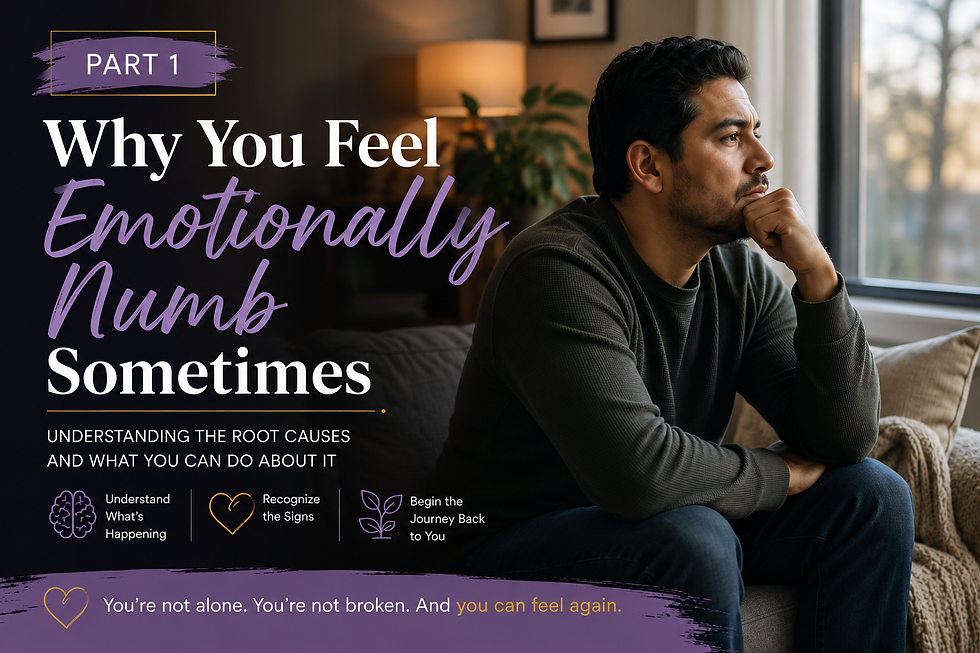
Why You Feel Emotionally Numb Sometimes (And How to Reconnect With Your Emotions)


There are moments in life when emotions seem to disappear.
You may not feel deeply sad.
You may not feel especially happy either.
Instead, you simply feel...nothing.
The things that once brought joy no longer excite you.
Conversations feel distant.
Laughter feels forced.
Even the people you love may seem emotionally far away, despite being right beside you.
Many people describe emotional numbness by saying:
"I feel empty."
"I don't know what's wrong with me."
"I can't cry anymore."
"I feel disconnected from everything."
"I'm just going through the motions."
If you've ever felt this way, you are not alone.
Emotional numbness is far more common than many people realize.
It is also one of the most misunderstood emotional experiences.
Some people worry they've become cold or uncaring.
Others believe they've simply "lost themselves."
In reality, emotional numbness is often the mind and body's way of coping with prolonged emotional strain.
Rather than being a sign that you no longer have emotions, it may actually be a sign that your emotional system has been working overtime for far too long.
Understanding why emotional numbness happens is one of the first steps toward reconnecting with yourself and the people around you.
What Is Emotional Numbness?
Emotional numbness is the experience of feeling disconnected from your emotions or unable to experience them with the same intensity as before.
It doesn't necessarily mean you feel nothing at all.
Many people still experience emotions.
They simply feel muted, distant, or difficult to access.
Instead of fully experiencing joy, sadness, excitement, or love, everything may feel emotionally flat.
Some people compare it to watching life through a window.
You're present.
You can see what's happening.
But you don't feel fully connected to it.
Others describe it as living on autopilot.
The days continue.
Responsibilities are completed.
Life moves forward.
Yet emotionally, everything feels strangely quiet.
Emotional Numbness Is Not the Same as Sadness
One reason emotional numbness is often overlooked is because it doesn't always resemble depression in the way people expect.
Many assume depression always means crying, overwhelming sadness, or constant despair.
As we discussed in Depression Isn't Always Sadness: 15 Signs You Shouldn't Ignore, depression often presents very differently.
For some people, the most noticeable symptom isn't sadness.
It's emotional emptiness.
Instead of feeling overwhelmed by painful emotions, they struggle to feel much of anything.
This difference is important.
People experiencing emotional numbness sometimes dismiss their symptoms because they aren't "sad enough."
They tell themselves:
"If I were really struggling, I'd be crying."
But emotional numbness can be just as distressing as overwhelming sadness.
Sometimes even more so.
Why Does Emotional Numbness Happen?
Our minds are remarkably adaptive.
When life becomes emotionally overwhelming, the brain sometimes protects us by reducing the intensity of our emotional experiences.
This protective response isn't something we consciously choose.
It's an automatic survival strategy.
Imagine carrying an increasingly heavy backpack every day.
Eventually, your body begins adjusting to the weight.
Emotional experiences can work in a similar way.
After prolonged stress, grief, trauma, anxiety, or depression, the nervous system may reduce emotional sensitivity in an effort to conserve energy and protect you from becoming overwhelmed.
While this response may temporarily reduce emotional pain, it can also make positive emotions more difficult to experience.
Joy.
Excitement.
Love.
Hope.
They may all begin feeling more distant.
Emotional Numbness Can Have Many Causes
Emotional numbness is not a diagnosis.
It's a symptom that can develop for many different reasons.
Understanding the underlying cause helps determine the most effective path toward healing.
Some common contributors include:
prolonged stress
depression
anxiety
burnout
grief
trauma
chronic emotional overwhelm
relationship difficulties
major life transitions
Sometimes emotional numbness develops gradually.
Other times it appears after a particularly difficult experience.
Every person's journey is different.
Depression and Emotional Numbness
Depression is one of the most common reasons people experience emotional numbness.
Many individuals expect depression to feel intensely emotional.
Instead, they often report feeling emotionally disconnected.
Activities they once loved no longer bring enjoyment.
Relationships feel more distant.
Life loses its color.
This experience is sometimes called anhedonia, or the reduced ability to experience pleasure.
It's one reason depression can feel so isolating.
The absence of joy often becomes just as painful as the presence of sadness.
Anxiety Can Also Lead to Emotional Numbness
At first glance, anxiety and emotional numbness may seem completely opposite.
Anxiety feels intense.
Emotional numbness feels empty.
Surprisingly, the two are often connected.
Living in a constant state of worry places tremendous strain on the nervous system.
When someone spends weeks, months, or years feeling constantly on alert, emotional exhaustion often follows.
Eventually, the mind may begin shutting down emotional intensity simply to cope.
As we explored in What Anxiety Really Is (And Why It Feels So Overwhelming), chronic anxiety affects both the brain and body.
Emotional numbness can become one of its long-term consequences.
Burnout Can Leave You Feeling Emotionally Empty
Burnout affects more than productivity.
It affects emotional capacity.
People experiencing burnout often describe feeling:
detached
cynical
exhausted
emotionally unavailable
disconnected from their work and relationships
When emotional resources become depleted, it becomes increasingly difficult to experience positive emotions.
As discussed in Burnout: When Stress Turns Into Emotional Shutdown, emotional numbness frequently develops after prolonged periods of chronic stress.
The mind isn't choosing to disconnect.
It's trying to survive.
Trauma and Emotional Protection
Trauma can also contribute to emotional numbness.
When people experience overwhelming events, the nervous system sometimes protects them by limiting emotional awareness.
This response can continue long after the original event has ended.
People may notice:
difficulty experiencing joy
feeling detached from others
emotional distance
feeling "checked out"
struggling to access memories or emotions
These reactions are not signs of weakness.
They are protective responses developed during overwhelming circumstances.
Healing often involves helping the nervous system gradually rediscover a sense of safety.
Why People Often Don't Recognize Emotional Numbness
Unlike sadness or anxiety, emotional numbness is difficult to describe.
Many people simply know that something feels different.
They may say:
"I don't feel like myself."
"I'm just existing."
"I can't explain what's wrong."
Because numbness often develops gradually, people adapt to it without realizing how disconnected they've become.
They continue meeting responsibilities.
Going to work.
Taking care of others.
Smiling when expected.
Meanwhile, they quietly lose touch with their own emotional experiences.
It isn't until someone asks,
"How are you really doing?"
that they realize they don't know how to answer.
Common Myths About Emotional Numbness
Misunderstanding emotional numbness often creates unnecessary shame.
Let's address a few common myths.
Myth: Emotional numbness means you're cold or uncaring.
False.
Most people experiencing emotional numbness care deeply.
They simply struggle to access or express their emotions.
Myth: You're choosing to feel this way.
False.
Emotional numbness is generally an automatic protective response—not a conscious decision.
Myth: If you're not crying, you're probably okay.
False.
Many people experiencing depression, trauma, or burnout rarely cry.
Instead, they feel emotionally disconnected.
Myth: Emotional numbness means you'll never feel normal again.
False.
With appropriate support and treatment, many people gradually reconnect with their emotions and regain a greater sense of joy, connection, and purpose.
Reconnection Begins With Understanding
One of the most powerful things you can realize is that emotional numbness is not a personal failure.
It is often your mind and body signaling that they've been carrying more than they were designed to carry alone.
Rather than criticizing yourself for feeling disconnected, try approaching your experience with curiosity.
Ask yourself:
What has life been asking of me lately?
How long have I been carrying this stress?
When did I last truly feel like myself?
What might my mind be trying to protect me from?
These questions create compassion.
And compassion often becomes the beginning of healing.
10 Signs You May Be Emotionally Numb
Emotional numbness does not always arrive suddenly.
For many people, it develops slowly.
At first, you may simply feel tired.
Then less interested in things.
Then more disconnected from conversations, relationships, and even yourself.
Because these changes happen gradually, they can be difficult to recognize.
You may continue working, parenting, socializing, and completing daily responsibilities while quietly feeling less emotionally present.
The following signs do not automatically mean you are experiencing depression, trauma, or another mental health condition. However, if several of these experiences persist or begin interfering with your relationships, motivation, or daily functioning, they deserve attention.
Recognizing emotional numbness is not about placing a label on yourself.
It is about understanding what your mind and body may be communicating.
1. You Rarely Feel Excited Anymore
You may still participate in activities you once enjoyed.
You attend celebrations.
Watch your favorite shows.
Spend time with friends.
Plan vacations.
But the anticipation and excitement seem to be missing.
Instead of looking forward to things, you may think:
“It will probably be fine.”
“I guess I should go.”
“I don’t really care either way.”
This does not necessarily mean you have stopped caring about your life.
It may mean your emotional system is depleted.
When the nervous system has spent too long responding to stress, anxiety, depression, or emotional overwhelm, positive emotions can become harder to access.
The absence of excitement is often one of the earliest signs that something has changed internally.
2. You Struggle to Cry or Express Emotion
Some people experiencing emotional numbness know they are hurting but cannot access the emotion fully.
They may feel pressure building inside without being able to release it.
They might say:
“I feel like I need to cry, but I can’t.”
“I know this should upset me more.”
“I feel something, but I don’t know what it is.”
This can be confusing, especially for people who were previously able to express emotions more easily.
Difficulty crying does not mean the emotion is absent.
Sometimes it means the nervous system has learned to suppress emotional intensity as a form of protection.
You may also have learned earlier in life that showing emotion was unsafe, inconvenient, or discouraged.
Over time, emotional suppression can become automatic.
3. You Feel Disconnected From People You Love
Emotional numbness often affects relationships.
You may know intellectually that you love your partner, children, family members, or friends.
Yet emotionally, the connection feels muted.
You may find yourself:
withdrawing from conversations
avoiding affection
struggling to feel present
responding automatically
feeling distant even when you are together
This distance can create guilt.
You may wonder why you cannot feel the closeness you once experienced.
The important thing to understand is that emotional disconnection does not necessarily mean love has disappeared.
Often, your capacity for emotional connection has been reduced by exhaustion, depression, anxiety, burnout, or unresolved stress.
The emotional safety discussed in Emotional Safety in Relationships: What It Is and Why It Matters can be an important part of reconnecting. When people feel accepted, understood, and unpressured, emotions often begin returning gradually.
4. You Feel Like You Are Living on Autopilot
You wake up.
Get ready.
Go to work.
Complete responsibilities.
Come home.
Go to bed.
Then repeat the same routine the next day.
Life may feel less like something you are participating in and more like something happening around you.
You may complete tasks without feeling connected to them.
Conversations happen, but you barely remember them.
Days pass without feeling distinct from one another.
This autopilot experience is common during emotional exhaustion.
The brain begins prioritizing basic functioning over emotional engagement.
You continue doing what needs to be done, but there is little emotional energy left for curiosity, joy, creativity, or connection.
5. You Avoid Emotional Conversations
When emotional access becomes difficult, conversations about feelings can feel uncomfortable or overwhelming.
You may change the subject when someone asks how you are doing.
You may respond with:
“I’m fine.”
“I’m just tired.”
“There’s nothing to talk about.”
Sometimes you genuinely do not know what you are feeling.
Other times, discussing emotions feels like opening a door you are not sure you can close again.
Avoidance can provide short-term relief.
However, it often increases isolation over time.
The goal is not to force yourself into intense emotional conversations before you feel ready.
It is to begin creating safe, manageable opportunities for honesty.
That may mean speaking with one trusted person, writing privately, or discussing your experience with a therapist.
6. Nothing Feels Especially Meaningful
Emotional numbness can reduce your sense of purpose.
Activities, goals, relationships, and responsibilities may begin feeling less meaningful than they once did.
You may ask yourself:
“What is the point?”
“Why does any of this matter?”
“Why am I doing all of this?”
These questions can sometimes reflect exhaustion rather than a complete loss of purpose.
When emotional resources are depleted, the brain may struggle to connect daily actions with meaning or hope.
This is especially common when numbness occurs alongside depression.
As discussed in Depression Isn’t Always Sadness: 15 Signs You Shouldn’t Ignore, depression may appear as emptiness, reduced motivation, or emotional flatness rather than obvious sadness.
7. You Are Physically Present but Emotionally Absent
You may sit through conversations while feeling mentally far away.
You may attend family dinners, work meetings, social gatherings, or important events without feeling fully present.
Others may not notice.
You nod.
Smile.
Respond when expected.
Internally, however, you feel detached.
Some people describe this as watching themselves from a distance.
Others say they feel like they are performing their role rather than genuinely participating.
This emotional absence is often the nervous system’s attempt to conserve energy or reduce overwhelm.
It can be especially common after prolonged stress or emotionally demanding experiences.
8. You Isolate Yourself More Often
When connection feels difficult, isolation can begin feeling easier.
You may ignore messages.
Cancel plans.
Avoid phone calls.
Spend more time alone.
Solitude can be healthy and restorative.
Isolation is different.
Isolation often comes with a sense of disconnection, avoidance, or emotional withdrawal.
You may want connection but feel unable to participate in it.
Unfortunately, isolation can reinforce emotional numbness.
The less connected you feel, the harder it may become to reach out.
This creates a cycle:
You feel numb, so you withdraw.
You withdraw, so you feel more disconnected.
Breaking this cycle does not require forcing yourself into large social situations.
It may begin with one safe conversation, a short walk with someone you trust, or simply replying to one message.
9. You Cannot Identify What You Are Feeling
When someone asks how you feel, you may genuinely not know.
You may recognize physical sensations such as:
tightness in your chest
fatigue
restlessness
heaviness
tension
But identifying the emotion underneath feels difficult.
This experience is sometimes described as emotional disconnection or reduced emotional awareness.
You may know something is happening internally without being able to name it.
Developing emotional language can be helpful.
Instead of asking only, “How do I feel?” try asking:
Do I feel heavy or restless?
Do I want closeness or space?
Do I feel hurt, afraid, angry, or disappointed?
What happened immediately before this feeling appeared?
You do not need the perfect word.
The goal is gradually rebuilding awareness.
10. You Wonder Whether Something Is Wrong With You
Perhaps the most painful part of emotional numbness is the self-judgment that often follows.
You may think:
“Why can’t I feel grateful?”
“Why don’t I enjoy anything?”
“Why do I feel disconnected from everyone?”
“What is wrong with me?”
These thoughts often create additional shame.
But emotional numbness is not evidence that you are broken.
It is often evidence that you have been overwhelmed, depleted, or emotionally guarded for a long time.
Your nervous system may have reduced emotional intensity because it believed that was the safest way to keep functioning.
Healing begins when self-criticism is replaced with curiosity and compassion.
How Emotional Numbness Affects Daily Life
Emotional numbness rarely stays contained in one area.
It can affect work, relationships, parenting, decision-making, and your overall sense of identity.
At Work
You may continue completing responsibilities while feeling less engaged.
Tasks may take longer.
Creativity may decrease.
Concentration may become more difficult.
You may feel as though you are performing rather than participating.
This can be mistaken for laziness or lack of ambition when the real issue is emotional depletion.
In Relationships
Partners and loved ones may interpret emotional distance as rejection.
They may assume you no longer care or are no longer invested.
This can create misunderstanding on both sides.
Honest communication can help.
Even saying:
“I care about you, but I have been feeling emotionally disconnected lately,”
can reduce confusion and create an opening for support.
In Parenting
Parents experiencing emotional numbness may continue meeting every practical need while struggling to feel emotionally present.
This often creates guilt.
It is important to remember that emotional exhaustion does not make someone a bad parent.
It means they may need additional support, rest, and opportunities for emotional recovery.
In Decision-Making
When emotions feel distant, decision-making can become harder.
Emotions often help us identify what matters, what feels safe, and what aligns with our values.
Without that emotional information, choices may feel flat or confusing.
You may know the facts but struggle to know what you actually want.
Emotional Numbness Can Be a Signal, Not a Sentence
Emotional numbness can feel permanent when you are living inside it.
But it is not necessarily permanent.
It is often a signal that your emotional system needs care.
It may be signaling:
prolonged stress
burnout
unresolved grief
depression
anxiety
trauma
lack of emotional safety
chronic self-neglect
The goal is not to force yourself to feel everything immediately.
The goal is to understand what has contributed to the numbness and begin rebuilding emotional capacity safely.
That process may involve slowing down, reconnecting with your body, reducing stress, speaking honestly with someone you trust, and seeking professional support.

How to Reconnect With Your Emotions
Emotional numbness can make you feel as though you have lost access to an important part of yourself.
You may remember what joy, excitement, closeness, or motivation once felt like, but those emotions now seem distant. You may want to reconnect with the people around you yet feel unsure how to begin.
The most important thing to understand is that emotional reconnection cannot be forced.
Trying to pressure yourself to feel happier, more grateful, or more emotionally engaged often creates additional frustration and shame.
Healing usually happens more gradually.
It begins by helping your mind and body feel safe enough to experience emotions again.
The goal is not to suddenly feel everything at once.
The goal is to create small, manageable opportunities for awareness, expression, connection, and emotional recovery.
Start by Removing the Judgment
Many people respond to emotional numbness with harsh self-criticism.
They tell themselves:
“I should be happier.”
“I have no reason to feel this way.”
“What is wrong with me?”
“I should appreciate my life more.”
These thoughts may feel motivating, but they usually make emotional reconnection more difficult.
Judgment creates pressure.
Pressure often causes the nervous system to protect itself even more.
Instead of asking, “What is wrong with me?” try asking:
“What has my emotional system been carrying?”
This shift encourages curiosity rather than shame.
Emotional numbness often develops after prolonged stress, anxiety, depression, trauma, burnout, grief, or repeated emotional strain. Your mind may have reduced emotional intensity because it was trying to help you continue functioning.
That response deserves compassion.
Pay Attention to Physical Sensations
Emotions often appear in the body before we can identify them mentally.
When someone has felt disconnected for a long time, asking, “What am I feeling?” may be too difficult.
A more accessible question may be:
“What am I noticing in my body?”
You might notice:
heaviness in your chest
tension in your shoulders
restlessness in your legs
a tight stomach
low energy
shallow breathing
a lump in your throat
warmth in your face
These sensations can provide clues about emotions that are difficult to name.
For example, tightness may be connected to anxiety.
Heaviness may reflect sadness or exhaustion.
Restlessness may signal fear, frustration, or emotional overload.
You do not have to interpret every sensation correctly.
The purpose is simply to begin noticing yourself again.
Use Simple Emotional Check-Ins
Emotional awareness improves through regular, low-pressure practice.
You do not need to sit for an hour analyzing your deepest feelings.
A brief daily check-in can be enough.
Try asking yourself:
What happened today?
What did I notice in my body?
Did anything make me feel lighter or heavier?
Did I want connection or space?
What did I need but not express?
What emotion feels closest, even if it is faint?
You may begin with broad categories such as:
comfortable
uncomfortable
calm
tense
connected
disconnected
energized
depleted
As emotional awareness grows, more specific language often becomes easier.
Stop Forcing Positive Emotions
When people feel emotionally numb, they often focus entirely on trying to feel happy again.
That is understandable.
However, reconnecting with emotion means allowing access to the full emotional range, not only pleasant feelings.
Sadness, anger, disappointment, grief, and fear are not failures.
They are information.
If you pressure yourself to feel only positive emotions, your emotional system may continue remaining guarded.
Instead, practice making space for whatever appears.
You might say:
“I do not have to like this feeling, but I can notice it.”
“I can allow this emotion without letting it control me.”
“This feeling is temporary, even if it is uncomfortable.”
The goal is not to become overwhelmed.
It is to show your nervous system that emotions can be experienced safely.
Practical Ways to Begin Feeling More Connected
Emotional reconnection often grows through small, repeated experiences rather than dramatic breakthroughs.
The following practices can help create opportunities for emotions to return gradually.
Reconnect With Familiar Music
Music often reaches emotional areas that words cannot.
Choose songs that once felt meaningful to you.
You do not need to choose cheerful music.
Select something connected to a memory, relationship, life chapter, or feeling.
Pay attention to what happens physically and emotionally.
Does your breathing change?
Do memories surface?
Do you feel comfort, sadness, warmth, or irritation?
Even a small response is meaningful.
The purpose is not to create a particular emotion.
It is to notice whether something inside begins responding.
Spend Time in Nature
Natural environments can help reduce nervous system activation and create room for emotional awareness.
You might:
walk through a park
sit near a window
spend time beside water
notice the temperature of the air
listen to birds or rainfall
watch the sunrise or sunset
You do not have to turn the experience into a major wellness routine.
Even ten quiet minutes outdoors can help you reconnect with the present moment.
Revisit Activities You Once Enjoyed
When joy disappears, people often stop participating in activities they once loved.
This is understandable.
Why continue doing something that no longer feels rewarding?
The challenge is that waiting for motivation to return before taking action may deepen the disconnection.
Consider reintroducing activities gently.
You might:
cook a familiar meal
draw or paint
read a few pages
garden
play an instrument
work on a small project
watch a favorite movie
Do not measure success by whether the activity immediately makes you happy.
Instead, ask:
“Did I feel even slightly more present?”
Small moments of engagement can gradually rebuild emotional capacity.
Write Without Trying to Sound Profound
Journaling can be helpful, but many people avoid it because they believe they need to produce deep insights.
You do not.
Begin with simple observations.
For example:
“Today felt heavy.”
“I did not want to answer my phone.”
“I felt calmer after walking outside.”
“I became tense during that conversation.”
“I miss feeling excited.”
This kind of writing helps create a bridge between experience and emotional language.
Over time, patterns may become clearer.
Practice Mindful Awareness
Mindfulness is not about forcing your mind to become empty.
It involves noticing your experience without immediately judging or changing it.
Try spending a few minutes noticing:
five things you can see
four things you can feel
three things you can hear
two things you can smell
one thing you can taste
This grounding exercise can help bring attention back to the present when you feel disconnected or on autopilot.
Mindfulness may also help if emotional numbness is connected to anxiety, chronic stress, or overwhelm.
Allow Safe Connection
Emotional numbness often encourages withdrawal.
Unfortunately, prolonged isolation can deepen the sense of disconnection.
You do not need to attend a large social gathering or share every private emotion.
Begin with one emotionally safe person.
You might say:
“I have not been feeling like myself lately.”
“I feel disconnected, and I am trying to understand it.”
“I do not need you to fix this. I just need someone to listen.”
Safe relationships can help the nervous system relearn that emotional openness does not always lead to criticism, rejection, or overwhelm.
Our article on Emotional Safety in Relationships: What It Is and Why It Matters explores how supportive relationships create conditions where vulnerability and connection can return.
Create More Space for Rest
Sometimes emotional numbness is a sign of severe depletion.
When every day is filled with responsibilities, caregiving, work demands, emotional labor, and constant availability, the nervous system may have little capacity left for feeling.
Rest does not always mean sleeping.
It may include:
reducing unnecessary commitments
turning off notifications
spending quiet time alone
creating boundaries around work
asking for help
allowing an unfinished task to wait
doing something without trying to be productive
If chronic overgiving is contributing to emotional exhaustion, How to Protect Your Energy Without Feeling Selfish may offer additional guidance for creating more sustainable boundaries.
Reconnecting With Other People
Emotional numbness can create distance in relationships, but that distance does not have to remain permanent.
The people around you may not understand what is happening unless you explain it.
They may interpret your withdrawal as anger, rejection, or a lack of interest.
A simple, honest explanation can reduce confusion.
You might say:
“I care about you, but I have been feeling emotionally disconnected.”
“I am having trouble accessing my emotions right now.”
“I may seem distant, but I am trying to work through something.”
This does not require sharing every detail.
It simply gives the other person a more accurate understanding of your experience.
Ask for Specific Support
People often want to help but do not know what to do.
Instead of saying, “I need support,” try asking for something specific.
Examples include:
“Can we take a walk together?”
“Could you check in with me tomorrow?”
“Can you sit with me without trying to solve anything?”
“Would you help me make an appointment?”
“Can we have dinner without our phones?”
Specific requests reduce uncertainty and make support easier to provide.
Be Patient With Emotional Intimacy
You may not immediately feel fully connected to your partner, family, or friends again.
That does not mean the relationship is permanently damaged.
Emotional closeness often returns gradually as stress decreases and safety increases.
Begin with consistency.
Spend time together.
Communicate honestly.
Accept small moments of connection without expecting them to solve everything.
Healing does not always feel dramatic.
Sometimes it looks like staying in a conversation five minutes longer than you normally would.
When Professional Support May Help
Emotional numbness sometimes improves when stress decreases or life circumstances become more manageable.
However, persistent numbness may be connected to depression, anxiety, trauma, grief, burnout, or another mental health concern.
Consider speaking with a mental health professional if:
emotional numbness has lasted for several weeks
you no longer enjoy activities you once valued
your relationships are being affected
you feel disconnected from yourself
daily responsibilities feel increasingly difficult
you are withdrawing from everyone
you feel hopeless about reconnecting
numbness is connected to a traumatic experience
you are using alcohol or substances to cope
You do not need to wait until your symptoms become unbearable.
Early support may help prevent emotional disconnection from becoming more deeply established.
How Therapy Helps With Emotional Numbness
Therapy creates a structured, supportive environment where you can explore emotional numbness without pressure or judgment.
A therapist may help you:
identify when the numbness began
understand what may be contributing to it
recognize patterns of emotional suppression
improve emotional awareness
regulate your nervous system
process grief, trauma, or chronic stress
rebuild connection with yourself and others
create healthier coping strategies
Different therapeutic approaches may be helpful depending on the underlying cause.
At Full Circle Counseling & Wellness, treatment may include evidence-based approaches such as:
Cognitive Behavioral Therapy
mindfulness-based therapy
trauma-informed therapy
EMDR
Acceptance and Commitment Therapy
somatic approaches
individual counseling
couples or family counseling when relationships are affected
Therapy should never force you to experience emotions before you are ready.
A thoughtful therapist helps you reconnect at a pace that feels safe and manageable.
You Are Not Broken Because You Feel Disconnected
Emotional numbness can convince you that something essential has disappeared.
You may worry that you will never feel like yourself again.
But numbness is often not the absence of emotion.
It is emotion placed behind a protective barrier.
That barrier may have helped you survive a difficult season.
It may have allowed you to keep working, parenting, caregiving, or functioning when your emotional system felt overwhelmed.
You do not need to hate yourself for developing a protective response.
You can appreciate why it appeared while also deciding that you are ready for something different.
Healing begins with patience.
With noticing.
With allowing.
With one honest conversation.
With one moment of rest.
With one small experience that reminds you that you are still here.
Begin the Journey Back to Yourself
You deserve more than simply going through the motions.
You deserve to feel connected to your life, your relationships, and your own emotional experience.
If you have been feeling emotionally numb, detached, or unlike yourself, you do not have to figure it out alone.
At Full Circle Counseling & Wellness, we help individuals throughout Frankfort, Chicago, and surrounding communities understand emotional numbness, depression, anxiety, burnout, trauma, grief, and chronic emotional overwhelm.
Through our Individual Counseling Services, you can explore what is contributing to your disconnection and develop practical tools for emotional healing. Our therapists also provide Anxiety Therapy, Depression Support, Trauma-Informed Therapy, and relationship-focused counseling when emotional numbness is affecting connection with others.
You can also visit our main Support Page to explore the full range of services available through Full Circle Counseling & Wellness.
You are not cold.
You are not uncaring.
You are not permanently disconnected.
Your emotions may have become quiet because your mind and body were trying to protect you.
With compassionate support, emotional safety, and time, you can begin hearing them again.
Key Takeaways
Emotional numbness is often a protective response to prolonged stress, depression, anxiety, trauma, grief, or burnout.
Feeling disconnected does not mean you have stopped caring.
Reconnecting with emotions should happen gradually and without pressure.
Physical sensations can provide clues when emotions are difficult to identify.
Small daily check-ins help rebuild emotional awareness.
Music, nature, journaling, mindfulness, and familiar activities can support emotional reconnection.
Safe relationships create space for vulnerability and healing.
Rest and healthier boundaries may be necessary when numbness is connected to depletion.
Therapy can help identify the causes of emotional numbness and support safe reconnection.
Emotional numbness is not necessarily permanent, and healing is possible.
Frequently Asked Questions
What causes emotional numbness?
Emotional numbness may be connected to depression, anxiety, trauma, grief, chronic stress, burnout, emotional overload, relationship difficulties, or major life changes. It is often the nervous system’s way of reducing emotional intensity when life feels overwhelming.
Is emotional numbness a sign of depression?
It can be. Some people experience depression primarily as emptiness, disconnection, reduced pleasure, or emotional flatness rather than obvious sadness.
Can anxiety make you feel emotionally numb?
Yes. Chronic anxiety can exhaust the nervous system. After long periods of heightened alertness, some people begin feeling emotionally depleted or disconnected.
How long does emotional numbness last?
The duration depends on the underlying cause, the level of support available, and whether the contributing stressors are addressed. Some people improve as stress decreases, while others benefit from professional counseling.
Should I force myself to feel emotions?
No. Forcing emotional intensity can create additional pressure. A safer approach is to build awareness gradually through body check-ins, journaling, mindfulness, supportive relationships, and therapy.
Why do I feel disconnected from people I love?
Emotional numbness can reduce your capacity to experience closeness even when love remains present. Stress, depression, anxiety, burnout, or trauma may make emotional connection harder to access temporarily.
Can emotional numbness affect parenting?
Yes. Parents may continue meeting their children’s practical needs while struggling to feel emotionally present. This does not make someone a bad parent. It may be a sign that the parent needs additional support and emotional recovery.
Can therapy help me feel emotions again?
Yes. Therapy can help you understand what contributed to the numbness, improve emotional awareness, regulate your nervous system, process difficult experiences, and rebuild connection at a safe pace.
What is one small step I can take today?
Begin with a short, judgment-free check-in. Notice one physical sensation, one emotional word that feels close, and one small thing you need today.
When should I seek immediate help?
Seek immediate professional or emergency support if emotional numbness is accompanied by thoughts of self-harm, suicide, feeling that life is not worth living, or an inability to stay safe. Contact emergency services or a local crisis resource right away.


Comments